- Food processing equipment
Applications
Products
- Washing & drying systems
- Service
Menu
Menu
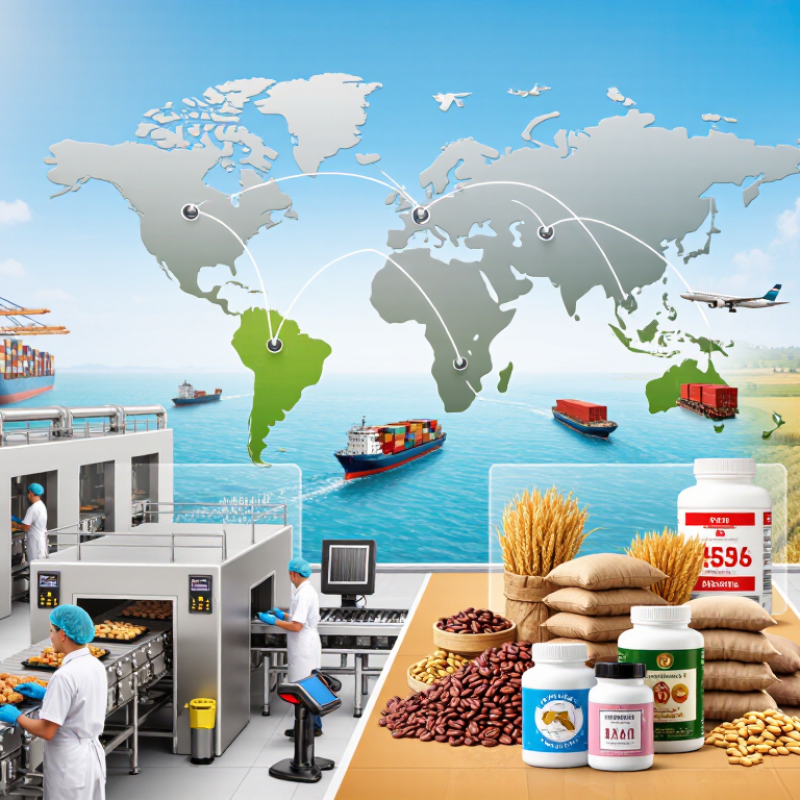
Global suppliers give food industries access to ingredients, packaging, technology, and seasonal products from multiple regions. A cocoa processor in Germany may depend on beans from Côte d’Ivoire, while a bakery chain may source wheat, enzymes, and cartons from different countries. This network can lower costs, stabilize supply, and support consistent product quality.
The FAO’s State of Agricultural Commodity Markets 2022 reports that global agri-food trade has more than doubled in real terms over the past two decades. The OECD-FAO Agricultural Outlook 2024–2033 also highlights continuing growth in agricultural production, consumption, and international trade. These figures explain the attraction of global sourcing. Scale matters. So does flexibility.
Yet the choice is not simply about cheaper ingredients. Suppliers must provide traceability, reliable testing, documented certifications, and clear delivery records. Chris Elliott, founder of the Institute for Global Food Security, has warned, “Food fraud is a global problem.” His statement remains highly relevant when ingredients cross several borders before reaching a factory.
Global sourcing can also expose food industries to port delays, extreme weather, currency changes, and inconsistent enforcement. A delayed container can leave a production line quiet by morning. That risk is easy to underestimate. Reports provide direction, but they cannot replace supplier audits or local experience. Companies may need dual sourcing, regional warehouses, and stronger digital tracking. No system is perfect. The better question is whether the supplier network can remain safe, transparent, and practical when conditions change.
Why Do Food Industries Choose Global Suppliers?
A global supplier is more than a company that exports food overseas. It is a producer or distributor serving multiple markets through coordinated sourcing, processing, logistics, and compliance systems. These suppliers usually provide consistent specifications, documented traceability, and reliable delivery across borders. A frozen ingredient may leave a certified facility, pass through temperature-controlled transport, and arrive with batch records intact.
The OECD-FAO Agricultural Outlook 2024–2033 projects global agricultural and fish commodity consumption to grow by about 1.1% annually. It also expects middle-income countries to generate most consumption growth. This pressure encourages food manufacturers to seek suppliers with wider production capacity and regional contingency plans. The FAO Food Outlook, November 2024, forecast the global food import bill at approximately US$2.1 trillion. That figure shows the scale of international food sourcing, but it does not guarantee quality. Global reach can still hide weak communication, uneven audits, or delays at ports.
Tips: Define the supplier’s role clearly. Check certifications, allergen controls, recall procedures, and cold-chain evidence. Request recent audit findings, not only polished brochures. Compare delivery performance across seasons. A strong supplier should explain its backup farms, facilities, and transport routes. Procurement teams should also test samples under real production conditions. Laboratory results alone can miss texture, yield, or packaging problems. The definition sounds straightforward, yet practical verification remains the difficult part.
| Decision Dimension | Definition in the Food Industry | Relevant Global Benchmark | Why Food Industries Use Global Suppliers | Reference and Data Year |
|---|---|---|---|---|
| International Market Access | The ability to source, manufacture, and distribute food ingredients or finished products across multiple national markets. | The Codex Alimentarius system includes 188 countries and the European Union as members. | Global suppliers are more likely to understand internationally recognized food standards and support documentation for cross-border trade. | Codex Alimentarius Commission, membership information, 2024. |
| Supply Availability | The capacity to provide food materials consistently despite seasonal production cycles, regional shortages, or changes in demand. | Approximately 13.2% of food is lost between harvest and retail globally. | A supplier operating across several sourcing regions can help food manufacturers access alternative production areas and reduce dependence on one harvest location. | Food and Agriculture Organization of the United Nations, global food-loss estimate, 2019. |
| Logistics Capability | The ability to coordinate international transport, warehousing, temperature control, customs procedures, and delivery schedules. | Around 80% of global merchandise trade by volume is transported by sea. | Global suppliers generally have experience with ocean freight, multimodal transport, import documentation, and international delivery planning. | United Nations Conference on Trade and Development, Review of Maritime Transport, 2023. |
| Food Safety Management | The systematic control of biological, chemical, and physical hazards throughout farming, processing, storage, transport, and distribution. | ISO 22000:2018 provides a food-safety management framework applicable to organizations throughout the food chain. | Working with suppliers that use recognized food-safety systems can make supplier qualification, audits, corrective actions, and compliance reviews more consistent. | International Organization for Standardization, ISO 22000:2018. |
| Product Traceability | The ability to identify the origin, processing history, movement, and destination of a food ingredient or product. | The Codex General Principles of Food Hygiene recognize traceability and recall procedures as important elements of food-hygiene control. | International suppliers with structured records can support origin verification, lot control, targeted recalls, and regulatory investigations. | Codex Alimentarius Commission, General Principles of Food Hygiene, CXC 1-1969, revised 2022. |
| Cost and Purchasing Scale | The use of larger production volumes, consolidated shipments, and international procurement networks to manage unit cost and purchasing efficiency. | International trade allows food materials to move from regions with suitable climate, land, labor, and production conditions to markets with demand. | Global suppliers may offer broader volume options, standardized specifications, and more efficient procurement for manufacturers with multi-market operations. | World Trade Organization, principles and overview of international trade, current reference framework. |
| Waste and Shelf-Life Management | The capability to manage product quality, inventory rotation, packaging, storage conditions, and expiry risks across the supply chain. | An estimated 19% of food available to consumers is wasted at the retail, food-service, and household stages. | Suppliers with strong forecasting, packaging, and distribution systems can help buyers improve delivery planning and reduce avoidable product loss. | United Nations Environment Programme, Food Waste Index Report, 2024. |
| Regulatory Adaptability | The ability to meet different requirements for labeling, additives, contaminants, allergens, packaging, import controls, and product claims. | Food businesses operate within national regulations that are supported by international reference standards, including Codex food-safety and labeling guidance. | Suppliers serving multiple markets can provide technical files, certificates, specifications, and compliance documents adapted to different regulatory environments. | Codex Alimentarius Commission, international food standards and guidelines, 2024. |